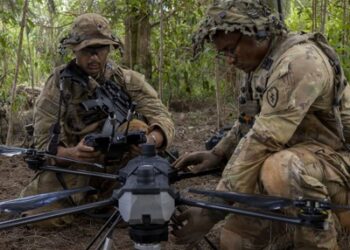
Even as the Pentagon designs new tactics and technology based on lessons learned from Ukraine, some observers believe the United States is undervaluing its relationship with Kyiv. This concern comes alongside the introduction of the Low-Cost Unmanned Combat Attack System (LUCAS), a one-way attack drone based on Russian Shahed-136 models recovered by Ukrainian forces. Developed by Arizona-based SpektreWorks, LUCAS made its debut earlier this year in a Pentagon display of new Department of Defense (DOD) programs. Officials heralded its open architecture, which enhances its utility in surveillance, reconnaissance, and coordination with other drones. Quoting Donald Trump, officials noted that LUCAS could be produced for $35,000 to $40,000 each, highlighting its potential effectiveness.
CENTCOM has now deployed a squadron of LUCAS drones for one-way attack missions. In conjunction with the Army, it is conducting further tests for various operational roles. While testing reports indicate that some drones have experienced malfunctions—such as veering off course or failing to launch—CENTCOM maintained that these incidents are not representative of the broader operational context.
The deployment of LUCAS demonstrates a new commitment to testing drones in-theater, allowing the military to experiment with low-cost options capable of overwhelming enemy air defenses. A CENTCOM official remarked that cheaper drones enable trials that occasionally result in crashes, a feedback loop lawmakers and commanders have consistently advocated for within the military context. This approach is characterized as “fail fast and cheap.”
However, LUCAS mirrors an Iranian-designed drone—mass-produced in Russia—underscoring the U.S. military’s lag in acquiring and refining advanced weaponry compared to Ukraine. Brig. Gen. Curtis King noted the rapid advancements in technology, citing the surprising capability of one country to deploy up to 600 one-way attack drones in just 24 hours—a feat he would not have believed possible just a few years ago.
In sharp contrast, U.S. progress in drone deployment has been limited, as LUCAS is primarily viewed as a threat emulator rather than a groundbreaking design. Ukraine’s role in shaping U.S. drone initiatives is evident through its engineering teams, who are advancing counter-drone defenses. Their development of affordable interceptor drones to down Shaheds stands in contrast to more expensive missile systems provided to Ukraine by the United States.
Ukraine has also made strides in 3D-printing drones near the front lines, outpacing U.S. efforts. A military leader at a recent U.S. Army event stated that studying Ukraine’s approaches has become a critical assignment for U.S. soldiers. However, experts suggest an enhanced collaboration between U.S. forces and Ukrainian engineers is vital. A soldier from a recent event voiced a need for more direct, face-to-face training with Ukrainian counterparts.
While a few U.S. companies are collaborating directly with Ukrainian units to design drones and equipment, these partnerships are often limited to specific contexts. There is potential for a more expansive relationship that would enable Ukraine to swiftly share battlefield intelligence with U.S. firms, allowing for quick identification of new opportunities and rectification of flaws in U.S. drones that have proven ineffective in Ukraine.
One notable example is the Skydio drone, which encountered significant operational challenges due to Russian GPS jamming. In response, Skydio announced a collaboration with data firm Armada to enhance drone functionality in disrupted environments. A former Ukrainian official lamented that the performance of U.S.-made drones in Ukraine has deteriorated over the past year, attributing this to a lack of testing ranges that simulate Russian electronic warfare scenarios.
Many U.S. defense contractors have been outsourcing the testing of their equipment to frontline Ukrainian units, often without sufficient reciprocal support. This has led to dissatisfaction among Ukrainian forces, who feel treated as unpaid consultants despite the acknowledgment of a lag in U.S. capabilities.
Political and business leaders from countries like the United Kingdom and Estonia are reportedly more receptive to establishing partnerships with Ukraine, in contrast to U.S. leaders. In July, Ukrainian President Volodymyr Zelensky indicated that Donald Trump was inclined to negotiate a deal involving U.S. purchases of Ukrainian drones.
However, since then, the political climate in the U.S. has shifted. Reports from October suggest that U.S. military leaders warned Ukrainian counterparts of the unsustainable nature of their military position, urging acceptance of a peace plan that would require territorial concessions from Ukraine. This growing unease within Ukraine regarding U.S. willingness to collaborate is likely to hinder future cooperation and trust between the nations, leading to sentiments analogous to a strained relationship where any provocation could result in severe repercussions.