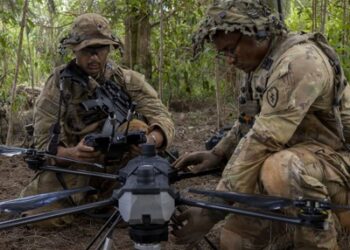
**TRUPPENÜBUNGSPLATZ PUTLOS TRAINING GROUND, Germany**—In a grassy area near the Baltic Sea, U.S. soldiers participated in a daylong training event that featured net-shooting hunter drones, specially outfitted 557 rifles, and .50-caliber machine guns. The training involved dropping numerous drones into the cold mud, representing a shift for the U.S. Army away from using $4 million missiles against $20,000 drones.
The event was part of **Project Flytrap**, an initiative aimed at enhancing counter-drone capabilities. More than 200 vendors expressed interest in participating in the November exercises, with 20 selected by the **Global Tactical Edge Acquisition Directorate**, a newly established procurement office focused on expediting gear acquisition for the field.
On **November 21**, media representatives and foreign military personnel witnessed a demonstration highlighting the integration of various products and their collective functionality. Brig. Gen. **Curtis King** of the **10th Army Air and Missile Defense Command** stated that insights from Ukraine about battlefield conditions have significantly influenced the U.S. Army in its development of new tactics, equipment, and weaponry.
Given the vulnerability of supply lines, the ability to manufacture drones close to the front lines is advantageous. During the demonstrations, a soldier from the 10th AAMDC showcased a **3D printer** capable of creating a drone frame within hours, which could act as an interceptor or part of a sensor mesh to locate enemy drones and their launch sites.
An emphasis on improved sensing capabilities was underscored as a vital element of cost-effective counter-drone strategies. King highlighted the successful integration of active radar and passive radar data to identify drone locations. This innovation allows data to flow seamlessly among various military units, enabling prompt and effective responses.
Additionally, an award was presented to **Armaments Research Company** for their portable drone-tracing technology, designed to empower soldiers to act as sensors on the battlefield, according to CEO Mike Canty, an Iraq War veteran. The technology showcased included an “aim assistant” from **Zeromark**, designed to assist soldiers in shooting down drones with bullets, a more practical approach than current laser technologies or jammers that fail against autonomous drones.
A noteworthy mention was Fortem’s **net-shooting drone**, which holds potential for operations in urban environments or near civilian populations. The demonstration also aimed to equip European officials with the tools necessary to defend against **Russian drones**, particularly in the context of potential U.S. withdrawal from its security commitments.
King explained that the showcased technologies are significantly less expensive, often costing a fraction compared to the drones they aim to neutralize, thus maintaining operational effectiveness while adhering to budgetary constraints.
When questioned by European journalists about the effectiveness of this technology against Russian drone activities, King and other Army officials refrained from providing definitive answers. They reiterated the importance of the U.S. remaining engaged within **NATO** and noted that future iterations of the FlyTrap event will include advancements in ground robotics and air-launched effects.
**Col. Chris Hill**, project manager for integrated fires mission command, emphasized the importance of involving soldiers from allied countries in the assessment process, asserting that firsthand military experience is crucial for validating these capabilities. The presence of various NATO flags at the event underscored the strategic focus on countries close to the threat posed by Russia.