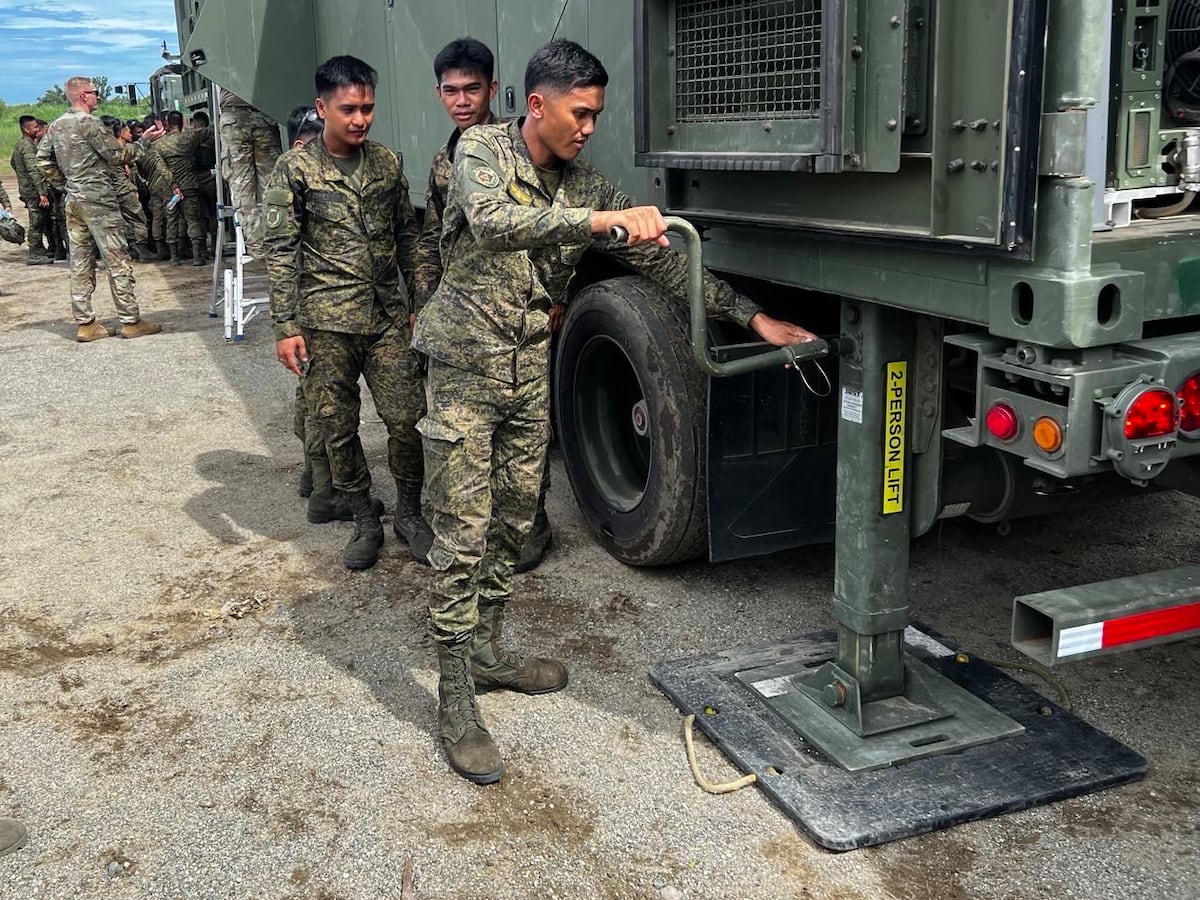
The U.S. Army will not conduct a live-fire operation of its Mid-Range Capability missile system, known as Typhon, during exercises in the Philippines this spring. This announcement was made by Maj. Gen. Jeffrey VanAntwerp, the deputy chief of staff of operations, plans, and training at U.S. Army Pacific, during a media briefing on Thursday.
This development comes nearly a year after the Army’s 1st Multi-Domain Task Force transported a Typhon launcher to Luzon, Philippines, as part of the previous year’s Salaknib exercise. This marked the first deployment of the Typhon missile system, which is considered vital to the U.S. Army’s strategy in the Indo-Pacific. The missile system traveled more than 8,000 miles from Joint Base Lewis-McChord, Washington, aboard a C-17 Globemaster cargo aircraft during a 15-hour flight.
The Typhon missile system has remained in the Philippines, which has drawn criticism from China, warning that its presence could destabilize the region. To date, officials have not conducted any live-fire tests of the system within the country.
Maj. Gen. VanAntwerp indicated uncertainty regarding how long Typhon will stay in the Philippines or whether it will be relocated within the Pacific theater. When asked about future locations for the missile system, he mentioned that plans are being made but deferred to the Office of the Secretary of Defense for more specific details.
The Typhon, developed by Lockheed Martin, consists of a vertical launch system that utilizes the Navy’s Raytheon-built Standard Missile-6 and Tomahawk missiles, enabling it to strike targets within a range of 500 to 2,000 kilometers. The integrated system comprises a battery operations center, four launchers, prime movers, and modified trailers. VanAntwerp emphasized that Typhon can engage ships and long-range land targets while being mobile and survivable.
As part of the upcoming Salaknib and Balikatan military drills, the Philippine Navy is set to fire C-Star, Spike Non-Line-of-Sight, and Mistral missiles; however, it will not use its BrahMos medium-range ramjet supersonic cruise missile due to its higher cost per shot.
The presence of Typhon in the Philippines has spurred interest from other countries in the Pacific regarding the potential hosting of the weapon system. A U.S. defense official noted that the Army had not anticipated the degree of deterrent effect Typhon would have, particularly in regards to China. One significant challenge remains the high costs associated with transporting the missile system across the Pacific if the intention is to rotate it among different countries.
Looking forward, the Army’s 3rd Multi-Domain Task Force, based in Hawaii, is scheduled to receive its own Typhon battery, which has already been certified at Joint Base Lewis-McChord. Col. Michael Rose, the commander of the 3rd MDTF, mentioned that the Army seeks opportunities to exercise such capabilities in theater, indicating the lessons learned from deploying it will be invaluable. The Typhon is expected to support Operation Pathways, which focuses on enhancing cooperation with regional allies and deterring Chinese influence.
Noah Robertson and Leilani Chavez contributed to this report.
**Author Bio:** Jen Judson is an award-winning journalist covering land warfare for Defense News. She has also worked for Politico and Inside Defense, holding a Master of Science degree in journalism from Boston University and a Bachelor of Arts degree from Kenyon College.